_edited.jpg)
Crohn’s disease , ulcerative colitis and breastfeeding

Inflammatory Bowel Disease and Breastfeeding: A Synthesis of Current Data

Inflammatory Bowel Diseases (IBD), comprising Crohn’s disease (CD) and ulcerative colitis (UC), predominantly affect women of childbearing age, with incidence peaking between 15 and 35–40 years. This overlap with the fertile years places breastfeeding at the center of concerns for both patients and healthcare providers. Two distinct questions must not be confused:
Does breastfeeding received in infancy play a role in the subsequent development of IBD?
Is breastfeeding one’s own child safe for a woman already diagnosed with IBD (risk of flare-up) and for her infant (exposure to medications)?
This synthesis reviews available data on these two axes, drawing from the most recent literature.
1. Breastfeeding in Infancy and the Risk of Developing IBD: Evolving Data
1.1 Historical Meta-Analyses Conclude a Protective Effect
Several case-control meta-analyses have long concluded a protective association between breastfeeding in infancy and the subsequent risk of IBD. The meta-analysis by Xu et al. (2017, Alimentary Pharmacology & Therapeutics), covering 35 studies (7,536 CD patients, 7,353 UC patients, 330,222 controls), found an odds ratio (OR) of 0.71 for CD and 0.78 for UC in breastfed subjects compared to those never breastfed.
The effect appeared dose-dependent: the risk reduction was most marked for breastfeeding lasting at least 12 months (OR around 0.20 for both CD and UC, compared to 3 or 6 months), and the benefit seemed more pronounced in Asian populations than in Caucasian ones. An earlier meta-analysis by Klement et al. (2004) reached the same conclusion, while highlighting the low methodological quality of most included studies.
These works rely almost exclusively on retrospective case-control studies, where exposure to breastfeeding is reconstructed by parents years, or even decades, later—a context prone to recall bias (parents of a sick child may remember the dietary history differently than those of a healthy child).
1.2 A Recent Large-Scale Prospective Cohort Finds No Association
A large prospective cohort study published in 2024 in Clinical Gastroenterology and Hepatology (Agrawal et al.) significantly nuances this picture. By combining three Scandinavian national birth cohorts (Denmark, Norway, Sweden; nearly 170,000 children followed for a median of 16 to 22 years), the authors found no association between the duration of exclusive or total breastfeeding and the risk of IBD, CD, or UC in offspring, regardless of how duration categories were defined.
The strength of this study lies in its methodology: prospective collection of exposure data (thus avoiding recall bias), very long-term follow-up via validated national registries, and large sample sizes. The authors note that two historical cohorts (the Nurses' Health Study and the Nova Scotia Atlee Perinatal Database) had already reported null associations, contrasting with the majority of case-control studies.
1.3 Reconciling These Data
The discrepancy between case-control studies (protective effect) and prospective cohort studies (no effect) illustrates an important methodological point: cohort studies, being less subject to recall bias and residual confounding, are considered more robust for this type of question. Nevertheless:
The Scandinavian data concern only populations with a high incidence of IBD and a high rate of confounding factors specific to these countries; their generalization to other contexts (particularly countries where the protective effect seemed more marked, such as some Asian populations) is not certain.
The follow-up (median 16–22 years) covers primarily pediatric and young adult-onset IBD, but not forms with later onset.
It is currently not possible to state with certainty that breastfeeding protects a child against the future onset of IBD. Public health recommendations in favor of breastfeeding remain valid for all their other benefits, but the "anti-IBD" argument must be contextualized for families, particularly those with a family history of IBD, to avoid placing an unjustified burden of guilt in case of non-breastfeeding.
2. Crohn’s disease , ulcerative colitis and breastfeeding : Maternal IBD Activity in the Postpartum Period
A frequent concern among patients is the fear that breastfeeding might trigger a flare-up. Current data are reassuring:
Recent recommendations indicate no increased risk of postpartum flare-up in women with CD, with a possibly slightly increased risk for UC: data primarily derived from the prospective ECCO-EpiCom cohort (209 pregnant women compared to 209 non-pregnant women) (Hoxha et al., 2025).
Older works (Kane and Lemieux, 2005) suggested a signal of increased flare-up risk associated with breastfeeding, mainly in patients with CD, but this effect disappeared after adjustment for treatment cessation: it is therefore not breastfeeding per se that seems to be the issue, but the cessation (often unjustified) of maintenance therapy at the time of breastfeeding.
More recent studies (Moffatt et al.; Yu et al.; systematic review by Malhi et al.) confirm no difference in flare-up risk between breastfeeding and non-breastfeeding women once this confounding factor is taken into account.
Maintenance therapy should not be discontinued solely due to breastfeeding, except in cases of formal contraindication. Premature cessation of treatments, often motivated by the unfounded fear of risk to the child, is the primary risk factor for postpartum flare-ups, not breastfeeding itself.
3. Safety of IBD Treatments During Breastfeeding
The main barrier to breastfeeding in women with IBD remains the widespread fear that maintenance treatments are dangerous for the breastfed infant. However, the vast majority of molecules used in IBD are now considered compatible with breastfeeding.
Reminder: (For more information: see our Pharmacology Training)
The compatibility of a medication with breastfeeding relies on the evaluation of several pharmacokinetic and pharmacodynamic parameters. These factors influence the amount of active substance passing into breast milk as well as its ability to be absorbed by the infant: plasma half-life of the drug, oral bioavailability in the infant, administered dose and frequency of administration (evaluation usually based on the Relative Infant Dose [RID], which compares the dose received via breast milk to the infant's body weight relative to the maternal dose), lipophilicity, molecular mass, plasma protein binding, and mode of transfer into breast milk.
Aminosalicylates (mesalazine, sulfasalazine, balsalazide, olsalazine): Minimal passage into milk, in the form of metabolites only. Considered compatible with breastfeeding. However, monitoring for the appearance of neonatal bloody diarrhea is advised with sulfasalazine (several cases reported in the 1980s).
Corticosteroids (prednisone, budesonide): Low concentrations in milk, peak reached about 2 hours after intake. A delay of 4 hours between intake and feeding is sometimes suggested but generally considered superfluous given the low levels found. They are compatible with breastfeeding.
Thiopurines (azathioprine, 6-mercaptopurine): Considered low risk. Active metabolites are most often undetectable in the blood of breastfed infants, and no clinical or developmental anomalies have been reported in follow-up studies (Gardiner et al., Moretti et al., Sau et al.). Asymptomatic neutropenia has been occasionally reported, with no major clinical consequence; simple monitoring suffices. These molecules are compatible with breastfeeding.
Methotrexate, Cyclosporine, Tacrolimus: The compatibility of methotrexate during breastfeeding varies depending on the dose: low weekly immunosuppressive doses are considered compatible with breastfeeding (E-lactancia, Lactmed). Note: Contradictory information appears in the Hoxha et al. 2025 article, but it is based on an article in a cancer journal, not on immunosuppressive doses.
Cyclosporine and tacrolimus are considered compatible with breastfeeding.
Anti-TNF (infliximab, adalimumab, golimumab, certolizumab pegol): These are large molecules with near-zero oral bioavailability: the small amount that passes into milk is likely degraded in the infant's digestive tract before absorption. Measured milk concentrations are well below the 10% of the maternal dose threshold usually considered reassuring. No major adverse effects have been reported in followed infants. These molecules are considered compatible with breastfeeding and can be continued without interruption.
Anti-integrins (vedolizumab, natalizumab) and Anti-IL-12/23 (ustekinumab): Vedolizumab and ustekinumab are considered low risk, with limited but reassuring data (normal infant development, no increase in infections). Natalizumab, less documented, is rather to be avoided out of caution.
Newer Molecules (risankizumab, mirikizumab, JAK inhibitors: tofacitinib, filgotinib, upadacitinib; S1P receptor modulators: ozanimod, etrasimod): Data are still insufficient to establish formal safety. JAK inhibitors and S1P modulators are currently rather discouraged during breastfeeding due to lack of data; for tofacitinib, if its use is deemed indispensable, temporary cessation of breastfeeding (around 18 to 36 hours after the last dose, depending on the formulation) is proposed.
Risankizumab and mirikizumab have high molecular mass (146,000 Da) and low oral bioavailability, which seems reassuring, but the Lactmed database mentions waiting 15 days before resuming treatment to avoid significant exposure of the newborn.
Antibiotics associated with IBD:
Amoxicillin-clavulanate: low risk, usable if needed.
Ciprofloxacin: low milk passage; if caution is desired, a delay of 3–4 hours between intake and feeding can be proposed, although no increased risk of osteo-articular issues has been demonstrated in the infant.
Metronidazole: compatible with breastfeeding; E-lactancia indicates that some authors propose a 12–24 hour window without exposure to breast milk after a 2g dose (but not for lower doses) to limit infant exposure.
Oral Vancomycin (treatment for Clostridioides difficile infection): compatible with breastfeeding.
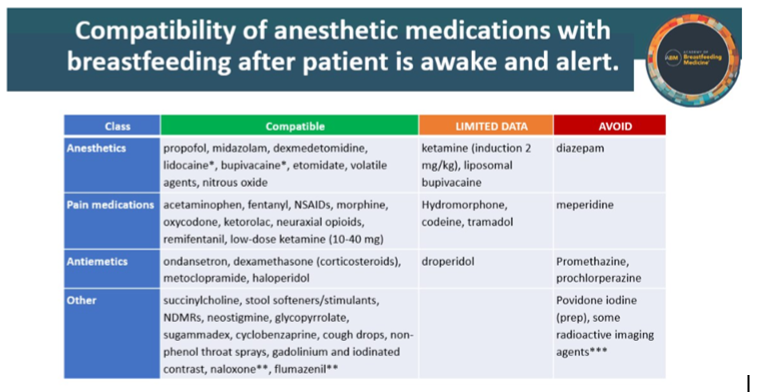
Medications Used for Additional Examinations (Colonoscopy, MRI): Women with IBD undergo regular additional examinations (surveillance colonoscopy, MRI) whose modalities often worry breastfeeding mothers, whereas available data are reassuring.
Colonoscopy: Sedation and Bowel Preparation There is no need to interrupt breastfeeding for bowel preparation or after usual sedation (midazolam, fentanyl, propofol): these molecules pass in minimal quantities into milk and are rapidly eliminated. The mother can resume breastfeeding as soon as she is sufficiently awake to do so safely. Regarding bowel preparation products:
Macrogols (polyethylene glycol, e.g., Movicol®, Laxido®, KleanPrep®) are poorly absorbed in the digestive tract and compatible with breastfeeding.
Sodium picosulfate (Picolax®) is not absorbed by the digestive tract; its active metabolite, although absorbed, is undetectable in milk. Breastfeeding can continue normally.
Senna (stimulant laxative) has not shown a difference in the frequency of loose stools or diarrhea in breastfed infants of mothers who took it, in a randomized double-blind trial involving several hundred women.
Phosphate enemas and bisacodyl have very low oral bioavailability and do not require interruption of breastfeeding. It is useful to reassure patients that the 24-hour fasting preceding the exam may transiently and slightly decrease milk production, but the resumption of frequent feeds generally restores it quickly.
MRI and Gadolinium Contrast Agents: Gadolinium-based contrast agents (gadoterate, gadodiamide, gadobenate, gadopentetate, gadoteridol, gadobutrol, etc.), used in MRI, pass in infinitesimal quantities into breast milk (less than 1% of the administered dose found in milk, of which only a tiny fraction, around 0.8%, is absorbed by the infant's digestive tract). Based on this, radiology societies (Royal College of Radiologists, American College of Radiology, European Society of Urogenital Radiology, Royal Australian and New Zealand College of Radiologists) consider it possible to continue breastfeeding normally after a gadolinium injection, without the need to interrupt feeds or pump and discard milk for 24 hours, as was long recommended out of excess caution. If the mother wishes to observe a precaution, a delay of 12 to 24 hours (never more) can be proposed, suggesting she pump milk in advance to feed the infant during this interval.
Infant Vaccination if Maternal Treatment is Maintained: A frequent question concerns the infant's vaccination when the mother continues her maintenance treatment during breastfeeding, particularly with biologics. It is important to distinguish two situations, which require different answers:
In utero exposure (maternal treatment during pregnancy): European recommendations (ECCO) recommend delaying live attenuated vaccines (BCG, rotavirus) in infants exposed in utero to biologic therapy until one year of age or until the molecule is no longer detectable in the infant's blood. North American recommendations (AGA) propose a 6-month delay for any child exposed in utero to biologic therapy, with the exception of certolizumab pegol (which does not cross the placenta or crosses very little, thus not justifying this precaution). This caution is based partly on reported cases of disseminated BCG infection in children who received this live vaccine after in utero exposure to biologic therapy.
Exposure via breast milk only (treatment maintained during breastfeeding, without in utero exposure, or after the precautionary period linked to it): The situation is different. Given the near-zero oral bioavailability of anti-TNF and other biologics and the infinitesimal amounts found in milk, both inactivated and live vaccines are considered safe in breastfed infants of mothers treated with biologics; the infant is not considered immunosuppressed solely due to this lactational exposure. The benefit of adhering to the national vaccination schedule is judged to be superior to the theoretical risk linked to residual exposure via milk. In practice, if a live vaccine (notably rotavirus) is administered to an infant whose mother is on immunosuppressants or biologics, simple hygiene measures (wearing gloves during changes in the days following vaccination) may be proposed as a precaution, although the rationale for this precaution remains debated since the child is not immunosuppressed.
4. Breastfeeding Rates in IBD
Despite these generally reassuring data, breastfeeding rates remain low in women with IBD compared to the general population. Several studies (notably the PIANO registry and a prospective study by Tandon et al.) highlight:
A frequent misperception: In a survey conducted in six Mediterranean countries, less than one-third of women with IBD interviewed had breastfed, while less than half even thought breastfeeding was possible in case of IBD.
Concerns centered on treatments: Fear of a harmful effect of medications on the infant, in a context where up to 13% of patients report having stopped a treatment to be able to breastfeed, often without real medical justification.
"Classic" lactation difficulties (insufficient production, difficulties latching) that add to IBD-specific concerns and remain the primary declared cause of early breastfeeding cessation in this population.
Heterogeneity of practices and messages depending on the healthcare professional consulted: In a Canadian study, nearly all gastroenterologists interviewed would maintain oral mesalazine treatment during breastfeeding, compared to less than half of other specialists and less than one-third of general practitioners: a sign of a need for continuing education on this topic.
A link between mode of delivery and breastfeeding observed in the general population (lower initiation, more difficulties, and earlier cessation after cesarean), which is not systematically found in specific IBD cohorts.
5. Breastfeeding and Specific Pain
Mothers who breastfeed while having IBD face significant challenges in managing their pain and the chronic fatigue that amplifies it. Even during remission, many mothers present residual abdominal pain, cramps, digestive discomfort, and transit disorders. These pains can be exacerbated by fatigue, lack of sleep, and an diet constrained by postpartum logistics.
Mothers may also experience extra-digestive pains such as arthritis, joint pain, and lower back pain (which can sometimes prevent any attempt at carrying the baby), or painful skin manifestations. These pains can make certain breastfeeding positions uncomfortable and/or painful, subsequently leading to nipple fissures due to improper baby positioning.
Regardless of IBD, mothers may combine all this with classic postpartum pains: perineal, scar, ligamentous, and breast pains. In these mothers, these pains can be more difficult to manage as they add to fatigue and pre-existing pains. However, oxytocin can theoretically reduce these painful sensations and improve digestion.
6. Practical Recommendations for Healthcare Professionals
Inform early, ideally during the pre-conception or antenatal period, about the compatibility of breastfeeding with the vast majority of IBD treatments: uncertainty and lack of information are the primary barriers identified.
Do not recommend stopping maintenance treatment solely due to breastfeeding, except in cases of formal contraindication (notably methotrexate); remind that it is the cessation of treatment, more than breastfeeding itself, that exposes to the risk of flare-up.
Anticipate practical lactation difficulties (milk production, latching) as for any mother, referring to a lactation consultant if needed. These difficulties remain the most frequent cause of early cessation, even before IBD-related concerns.
Prioritize multidisciplinary care (gastroenterologist, obstetrician/midwife, maternal-fetal medicine specialist, lactation consultant, dietitian), associated with better peripartum outcomes according to available data. Adapt treatments (e.g., avoid ibuprofen, which can trigger painful crises); and refer the breastfeeding mother to a dietitian to adjust her diet to the specific needs related to pregnancy and breastfeeding, especially for mothers with Crohn’s disease which entails greater malabsorption/deficiencies than ulcerative colitis (B12, folates, ADEK, electrolytes if diarrhea, fats, iron loss).
Adjust breastfeeding positions to specific needs: In case of a stoma, a position like the Gestalt position will avoid any pressure on the stoma bag.
Conclusion
Breastfeeding by an infant of a mother with IBD is globally safe, both for the mother (no increased risk of flare-up attributable to breastfeeding itself) and for the child (the majority of maintenance treatments, including most biologics, being compatible).
Bibliography
Ronchetti C, Cirillo F, Di Segni N, Cristodoro M, Busnelli A, Levi-Setti PE. Inflammatory Bowel Disease and Reproductive Health: From Fertility to Pregnancy-A Narrative Review. Nutrients. 2022;14(8):1591.
Agrawal M, Størdal K, Hansen AV, Östensson M, De Freitas MB, Allin KH, Jess T, Ludvigsson J, Mårild K. Breastfeeding Duration Is Not Associated With Offspring Inflammatory Bowel Disease Risk in Three Population-Based Birth Cohorts. Clin Gastroenterol Hepatol. 2024;22(12):2459-2467.
Xu L, Lochhead P, Ko Y, Claggett B, Leong RW, Ananthakrishnan AN. Systematic review with meta-analysis: breastfeeding and the risk of Crohn's disease and ulcerative colitis. Aliment Pharmacol Ther. 2017;46(9):780-789.
Hoxha T, Youssef M, Huang V, Tandon P. Inflammatory Bowel Disease and Breastfeeding: A Narrative Review. Inflamm Bowel Dis. 2025;31(1):210-219.
Jones W. Inflammatory Bowel Disease and Breastfeeding: Crohn's Disease and Ulcerative Colitis [fact sheet]. Breastfeeding and Medication; 2021.
Elise Armoiry, Breastfeeding Consultation in Organ Transplantation Recipients: Theoretical Background and a Case Report. Lactation & Breastfeeding.
E-lactancia. Methotrexate. Consulted 21/07/2026.
E-lactancia. Metronidazole. Consulted 21/07/2026.
Crohn’s and Colitis UK. Postnatal care and breastfeeding. 2025.


Comments